
Body treatments
truSculpt iD in Knightsbridge: How Radiofrequency Sculpts Stubborn Fat
A clear, evidence-first guide to monopolar radiofrequency body contouring: what truSculpt iD actually does to fat cells, what the published studies measured, who it suits, how it compares with fat freezing, and what to expect in Knightsbridge.
 By Fatemeh, Founder & Lead Practitioner, Levirgo Aesthetics Clinic 21 min read
Reviewed September 2026
What is truSculpt iD and how does radiofrequency reduce fat?
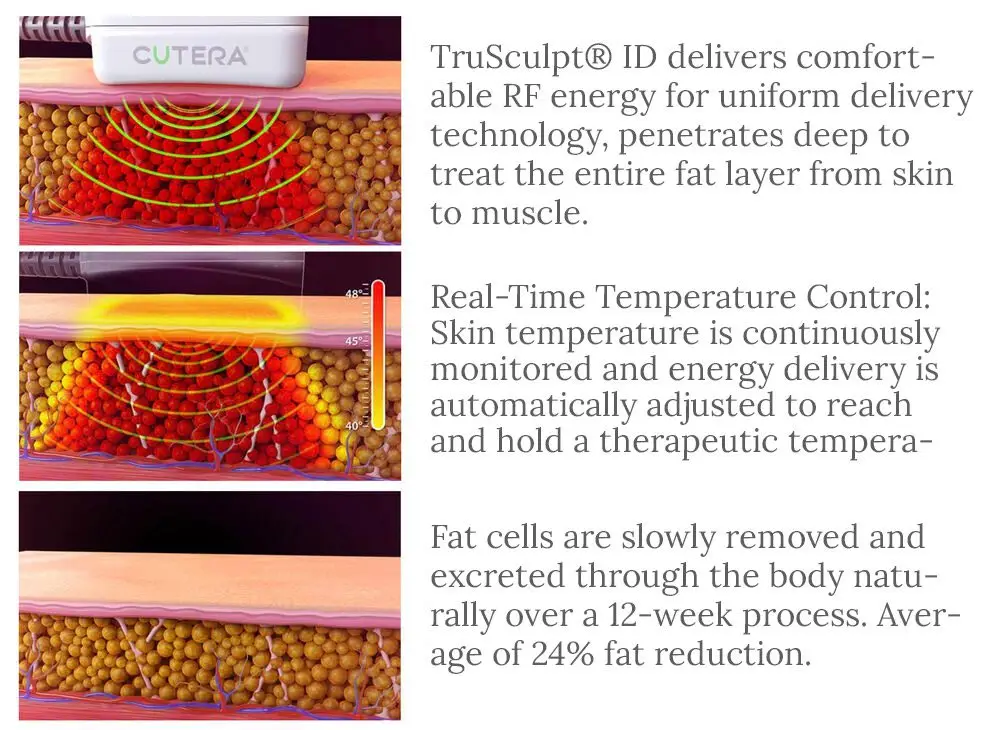
truSculpt iD is a monopolar radiofrequency device that heats the fat beneath the skin to a therapeutic temperature while sensors monitor the skin surface. Sustained heat injures fat cells, and the body removes them gradually over the following weeks, thinning the treated fat layer without needles, suction or surgery.
Radiofrequency is a form of electromagnetic energy. When it passes through tissue it makes water molecules and charged particles oscillate, and that movement produces heat. In a monopolar system the energy flows from a treatment applicator on the skin to a return pad elsewhere on the body, so it travels deeper than bipolar devices, where the current stays close to the surface between two electrodes. That depth is what allows the energy to reach the subcutaneous fat layer, the soft fat that sits between the skin and the muscle.
truSculpt iD, made by the US company Cutera, uses a 2 MHz frequency delivered through flat, hands-free applicators that are strapped against the skin. Up to six applicators can run at once. Each has temperature sensors that adjust the energy in real time so the skin stays within a comfortable, controlled range while the fat underneath warms. In its 2022 submission to the US Food and Drug Administration (FDA), the manufacturer reported skin-temperature testing showing the device holding the skin at 40 to 45°C without exceeding 45°C.
The aim is to hold fat cells (adipocytes) at a raised temperature for long enough to trigger cell injury and death, while temperature control protects the skin above. The immune system then clears the damaged cells over a period of weeks, which is why nothing visible happens on the day and the change builds gradually. Levirgo offers the treatment as part of its non-surgical fat loss service at 6 Beauchamp Place, Knightsbridge.
A useful way to think about it
truSculpt iD changes the thickness of a fat layer in a defined area. It does not change your overall weight, your metabolism or the fat around your organs. It is a contouring tool for people who are already broadly where they want to be.
What happens to fat cells after a treatment?
Tissue biopsies submitted to the FDA showed fat-cell death peaking about 30 days after treatment, affecting roughly a third of adipocytes to a depth of around 1.5 cm, while the skin layers above looked normal. By 90 days only minimal inflammation remained, consistent with the body having cleared the damaged cells.
The most direct evidence of what radiofrequency does inside the body comes from a histology study the manufacturer ran before an FDA clearance in 2018 (510(k) K180709). Twelve people who were already booked for a surgical tummy tuck had one side of the abdomen treated and the other side left untreated as a control. Tissue was taken during their surgery at intervals from the same day up to 90 days later and examined by a dermatopathologist.
The biopsies show a clear sequence. Acute inflammation was present from the day of treatment out to about 20 days, fat necrosis was most marked around day 30, and by day 60 it was confined to small focal areas affecting less than 20% of the tissue. At 90 days there was minimal inflammation. In practice, that timeline is why clinicians review results at around 12 weeks rather than a few days after treatment.
Two honest caveats. First, the response was not uniform: one participant showed no response at day 10, and the effect varied between people. Second, a biopsy study shows the biological mechanism, not how much visible change a person will see. For that, we need the clinical studies below.
Does truSculpt iD work? What the clinical studies show
Published studies report an average 22% to 24% reduction in fat-layer thickness 12 weeks after a single treatment, measured by ultrasound. The evidence is encouraging but based on small groups of 12 to 19 people, so individual results vary and a second session is sometimes planned.
The key study for the hands-free device is a two-site, single-blinded pilot trial published in Lasers in Surgery and Medicine in 2021. Nineteen people received a single 15-minute treatment with up to six 2 MHz applicators on the abdomen and flanks. At 12 weeks, blinded investigators recorded more than a one-point improvement on the Global Aesthetic Improvement Scale, ultrasound showed an average fat-thickness reduction of 24% on the abdomen and 22% on the flanks, most participants were satisfied, and side effects were mild and resolved on their own.
| Study | Design and participants | How it was measured | Main finding |
|---|---|---|---|
| Somenek et al., 2021 | Two sites, single-blinded, 19 people, one 15-minute session | Ultrasound, blinded photo rating at 12 weeks | 24% abdomen and 22% flanks fat-thickness reduction |
| Taub and Bartholomeusz, 2020 | Single group, 12 people, earlier truSculpt 3D handpiece, 60 minutes | Ultrasound at 8 and 12 weeks | 4.6 mm (24%) reduction; 10 of 12 people above 20% |
| FDA submission C-17-TS13 | 12 people due for tummy tuck, treated vs untreated side | Biopsy and histology to 90 days | Selective fat-cell death, skin layers unaffected |
| FDA submission C-17-TS15 | 15 people re-measured 18 months after treatment | Tape measure vs baseline | 2.30 cm reduction maintained with stable weight |
| Manuskiatti et al., 2022 | 12 people with overweight-range BMI, 1 RF session then 6 muscle-stimulation sessions | Waist circumference and skinfold | 3.1% waist reduction and up to 14% skinfold reduction at 1 month |
Sources: PubMed records for each paper and the FDA 510(k) summary K180709. None of these studies included more than 19 people, and only the earlier FDA pivotal circumference study used a sham-treated comparison group.
All figures are ultrasound-measured averages. Radiofrequency data: Somenek et al. 2021 and Taub and Bartholomeusz 2020. Fat freezing range: Ingargiola et al., Plastic and Reconstructive Surgery 2015, a systematic review of 19 cryolipolysis studies. Studies differ in design, so treat this as a broad comparison rather than a head-to-head result.
Read together, the data say that radiofrequency produces a measurable, moderate reduction in a treated fat layer, of a similar order to fat freezing. They do not tell us precisely who will respond best, and they cannot promise a particular result for you. That is why a good consultation measures and photographs the area first, so change can be judged objectively rather than by memory.
Who is a good candidate for truSculpt iD, and who is not?
The best candidates are close to their goal weight, with a stable weight and a localised area of soft fat that has not responded to diet and exercise. People seeking weight loss, those who are pregnant, or anyone with an implanted electronic device or metal in the treatment area are not suitable.
Where your body stores fat is shaped by genetics, hormones, age and sex, which is why the lower abdomen, flanks and inner thighs can hold on to fat even when the rest of your body is lean. truSculpt iD is designed for exactly that situation. The research reflects this: the FDA histology study, for example, enrolled people with a body mass index between 20 and 30.
You are likely to be a good fit if you
- Are at or near a weight you are happy with, and have been stable for several months
- Can see and pinch a defined area of soft fat on the abdomen, flanks, thighs, back, arms or under the chin
- Want a gradual, natural-looking refinement rather than a dramatic change
- Prefer a treatment with no needles, no suction and no downtime
- Understand that a second session may be recommended for some areas
Not suitable if you
Are pregnant or breastfeeding; have a pacemaker, defibrillator or other implanted electronic device; have metal implants in or near the treatment area; have an active skin infection, wound or rash in the area; or have a medical condition your practitioner judges makes heat-based treatment unsafe. A full medical history is taken first, and treatment is postponed or declined whenever there is doubt.
If weight loss rather than contouring is the main goal, that deserves a medical conversation first. Our guide to medically supervised weight-loss treatment explains how NICE sets eligibility, and body contouring can be revisited once your weight has settled.
Which areas can truSculpt iD treat?
truSculpt iD is used on the abdomen, flanks, back, thighs, upper arms and under the chin. The strongest published data are for the abdomen and flanks, and the device’s US FDA clearance for non-invasive lipolysis names the abdomen specifically, so expectations for other areas should be set carefully.
Because the applicators are flat and hands-free, several areas can be treated in the same appointment, and the layout can be tailored to your shape. This is one practical difference from vacuum-cup fat freezing, which needs tissue that can be drawn up into an applicator.
| Area | Typical concern | Strength of evidence | Practical notes |
|---|---|---|---|
| Lower and upper abdomen | A soft bulge that persists despite exercise | Strongest: multiple studies and FDA clearance | Most commonly treated area |
| Flanks | Love handles above the hips | Good: 22% average in one study | Often treated with the abdomen |
| Back and bra line | Soft rolls below the shoulder blades | Limited published data | Assessed case by case |
| Inner and outer thighs | Localised fat pads | Limited published data | Muscle tone often matters too |
| Upper arms | Soft tissue at the back of the arm | Limited published data | Skin laxity may need a separate plan |
| Under the chin | Submental fullness | Limited published data for this device | Smaller applicator, shorter session |
Evidence strength reflects the studies listed in this article and FDA 510(k) summaries K180709 and K221407.
If loose skin is the main issue, a dedicated skin tightening treatment is usually more effective. If dimpling is the concern, our cellulite reduction programme combines approaches, because cellulite involves the connective tissue under the skin as well as fat.
What happens during a truSculpt iD session?
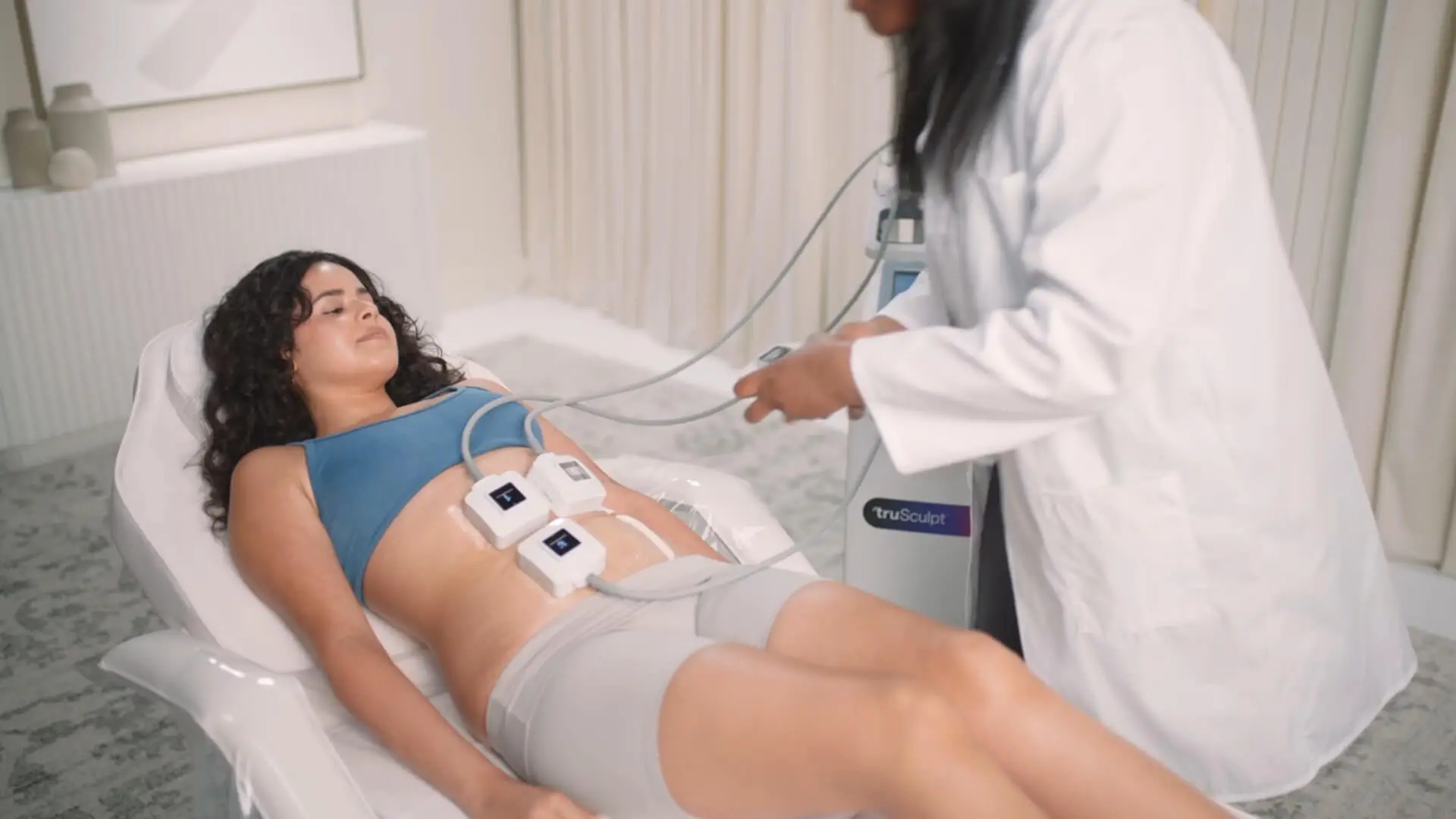
A session typically takes 15 to 30 minutes, depending on how many areas are treated. The practitioner maps the area, straps the flat applicators in place, and the device warms the tissue while you rest. Most people describe a deep warmth, similar to a hot stone massage, and return to normal activities straight away.
- Consultation and medical screening
Your history, medicines, implants and goals are reviewed. The practitioner examines the area, checks whether the concern is fat, skin laxity or muscle, and explains realistic outcomes and alternatives.
- Measurements and photographs
Standardised photographs and measurements are taken so that change can be assessed objectively at your review.
- Mapping and applicator placement
The treatment zones are marked and up to six flat applicators are secured with straps. A return pad completes the circuit. There are no needles and no suction.
- Warming phase
The applicators bring the tissue to temperature over the first few minutes and hold it there. Sensors adjust the energy continuously. Tell your practitioner if any spot feels too hot; settings can be changed straight away.
- Straight back to your day
Mild redness and warmth are normal for a few hours. You can walk to Knightsbridge Underground station, return to work or go to the gym the same day.
- Review at around 12 weeks
Photographs and measurements are repeated. If the area would benefit from more reduction, a second session may be discussed.
In the published trial, a single 15-minute session was enough to produce the reported change. In the earlier study using a gliding handpiece, patients rated discomfort at 2 to 4 out of 10. There is no anaesthetic, and no preparation is needed beyond wearing comfortable clothing and staying well hydrated.
When will I see results, and how long do they last?
Change appears gradually from about 6 to 8 weeks, with the full result usually judged at around 12 weeks. Fat cells that have been cleared do not grow back. In an 18-month follow-up, people whose weight stayed within 5% kept an average 2.30 cm reduction in waist circumference.
Nothing changes on the day of treatment because the body needs time to remove the injured cells. The earlier truSculpt study found a significant further improvement between the 8-week and 12-week reviews, which matches the biopsy timeline. This is also why clinicians discourage judging the result in the first month.
| Time after treatment | What is happening | What you may notice |
|---|---|---|
| Day 0 to 3 | Heat response and early inflammation | Warmth, redness, occasional tenderness |
| Weeks 1 to 4 | Fat-cell death building towards its peak at about day 30 | Little visible change; the area may feel firmer |
| Weeks 6 to 8 | Immune system clearing damaged cells | Early softening of the contour for some people |
| Week 12 | Most of the clearance complete | Result reviewed with photos and measurements |
| 18 months | Remaining fat cells stable if weight is stable | Result maintained in the FDA follow-up cohort |
Based on FDA 510(k) summary K180709 and Taub and Bartholomeusz 2020. Individual timelines vary.
On durability, the FDA follow-up is informative but has limits. Of 46 people originally treated, 15 were eligible and re-measured at 18 months; seven others were excluded because their weight had changed by more than 5%, and nine because they had chosen further treatment. Among the 15, the reduction held, with a non-significant 0.17 cm change since the 12-week visit. The lesson is simple: a stable weight protects the result, because the fat cells that remain can still expand.
Find out whether truSculpt iD suits your goal
Book a consultation in Knightsbridge. We will assess the area, measure and photograph it, explain realistic results and give you a written plan and price.
truSculpt iD vs fat freezing: which is better?
Both reduce a treated fat layer by a broadly similar amount. Radiofrequency heats fat through flat applicators and needs no suction, while cryolipolysis cools fat through a vacuum applicator. Fat freezing carries a rare risk of paradoxical fat enlargement, estimated at 0.22% in a 2025 meta-analysis, which is a factor for some people.
Cryolipolysis, often called fat freezing, is the most established non-invasive fat reduction method and has the larger evidence base. A systematic review of 19 studies in Plastic and Reconstructive Surgery found ultrasound-measured fat reductions ranging from 10.3% to 25.5%. Radiofrequency results sit in a similar range. The choice therefore tends to come down to the area, the character of the tissue, comfort and your attitude to specific risks rather than headline numbers.
| Factor | Radiofrequency (truSculpt iD) | Cryolipolysis (fat freezing) |
|---|---|---|
| How it works | Controlled heat injures fat cells | Controlled cold injures fat cells |
| Applicator | Flat, strapped on; no suction | Usually a vacuum cup that draws tissue in |
| Tissue needed | Soft fat, including areas hard to pinch | Generally tissue that fits the cup |
| Sensation | Deep warmth | Intense cold and pulling, then numbness |
| Typical session | 15 to 30 minutes, several areas at once | Varies by device and applicator |
| Reported fat reduction | 22% to 24% in published RF studies | 10.3% to 25.5% across 19 studies |
| Notable rare risk | Burns if poorly controlled; one case report of fat enlargement after a different RF device | Paradoxical adipose hyperplasia, pooled incidence 0.22% |
| Evidence base | Smaller and newer | Larger and longer-established |
Sources: Ingargiola et al. 2015 (cryolipolysis review), Mah et al., Aesthetic Surgery Journal Open Forum 2025 (PAH meta-analysis of 13,078 patients), Agochukwu-Nwubah and Mentz 2020 (RF case report), and the radiofrequency studies above.
About paradoxical adipose hyperplasia
Paradoxical adipose hyperplasia (PAH) is a firm enlargement of fat in a treated area that can appear months after cryolipolysis and usually needs surgery to correct. A 2025 meta-analysis of 28 studies estimated a pooled incidence of 0.22%, about 1 in 455 patients, higher than figures previously quoted by the manufacturer. A Canadian multicentre review found rates of 0.05% to 0.39% per treatment cycle. A single case after a different radiofrequency device has also been published, so no heat or cold treatment is entirely free of this possibility.
Liposuction remains the option that removes the most fat in one procedure, but it is surgery, with anaesthesia, recovery time and surgical risks. For a wider look at non-surgical fat reduction, muscle stimulation, skin tightening and cellulite treatment side by side, see our comparison guide to body contouring treatments in Knightsbridge.
Is truSculpt iD safe? Side effects and risks
In the published studies, side effects were mild and resolved without treatment, and no serious adverse events were reported. Expect temporary redness, warmth, swelling or tenderness. Rare risks include burns or tender nodules, which is why screening, correct settings and an experienced operator matter.
The safety data are reassuring for a treatment of this kind. In the FDA histology study, 11 of 12 participants had mild to moderate redness and swelling that settled within 1 to 4 hours; one had moderate redness and mild pain that lasted a day. In the 18-month follow-up, no treatment-related effects were reported after the 12-week visit. The 2021 trial reported mild, self-resolving effects and no serious adverse events.
| Effect | How common | What to do |
|---|---|---|
| Redness and warmth | Very common | Settles within hours; no action needed |
| Mild swelling | Common | Usually settles within a day |
| Tenderness or aching | Occasional | Simple measures; tell your clinic if it persists beyond a few days |
| Firm or tender nodules | Uncommon | Usually soften over weeks; report so they can be reviewed |
| Blistering or burn | Rare | Contact the clinic the same day for assessment |
| Uneven contour | Rare | Reviewed at 12 weeks; planning and mapping reduce the risk |
Frequency descriptions are based on the side effects reported in the studies cited in this article and are not precise rates.
Aftercare that genuinely helps
Drink water as normal, keep moving, avoid very hot baths or saunas on the treatment day if the skin is still warm, and keep your weight stable over the following months. There is no need for special garments or time off work.
How much does truSculpt iD cost in London?
Typical London prices are about £500 to £900 per area for one session, or £900 to £1,600 for a course of two on the same area. Treating the abdomen and flanks together over two sessions usually costs £1,600 to £2,800. Prices are indicative and confirmed in writing after assessment.
| Treatment plan | Typical London price | Good to know |
|---|---|---|
| One area, one session | £500 to £900 | Many people start here and review at 12 weeks |
| One area, course of two | £900 to £1,600 | Second session planned where more reduction is useful |
| Two areas, course of two | £1,600 to £2,800 | For example abdomen and flanks |
| Under the chin, course of two | £600 to £1,100 | Smaller treatment area |
Indicative 2026 London market ranges only, not a Levirgo price list. Your plan and price are confirmed in writing after a consultation, and there is no obligation to proceed.
When comparing quotes, check what is included: the consultation, measurements and photographs, the number of applicators and areas, the 12-week review and aftercare contact. A lower price for fewer applicators or no follow-up is not a like-for-like comparison. If you would like a personalised plan, you can book a consultation online or send the team a question first.
How to choose a body contouring clinic in the UK
Choose a clinic that assesses you medically, explains risks and alternatives, and offers a cooling-off period. In England, most non-surgical cosmetic treatments are not yet covered by a licensing scheme, so the questions you ask matter. The government confirmed plans for a risk-tiered licensing system in August 2025.
In its August 2025 response to a consultation that attracted 11,848 responses, the Department of Health and Social Care described current regulation of non-surgical cosmetic procedures as fragmented and set out plans for local authority licensing, with procedures grouped into green, amber and red tiers by risk, and age restrictions for under-18s. Until that framework is in force, responsibility for checking standards rests largely with you.
- Who assesses you? Ask who takes your medical history and whether a doctor or registered healthcare professional oversees treatment. Registration can be checked on the GMC or NMC registers.
- Is the device genuine and maintained? Ask which device is used, who services it, and what training operators have had on it.
- Will you be measured? Standardised photographs and measurements at baseline and review are a sign of a clinic that expects to be held to its results.
- Are risks and alternatives explained? The NHS advises asking what could go wrong and choosing a practitioner with insurance to correct problems.
- Is there a cooling-off period? The NHS says you should be offered one after any consultation, and that you can walk away if you are not comfortable.
- What happens if something goes wrong? Ask about aftercare contact, review appointments and complaints procedures before you pay.
Choose a reputable, safe and qualified practitioner.
NHS, Before you have a cosmetic procedure
The Joint Council for Cosmetic Practitioners (JCCP) runs a voluntary register for non-surgical practitioners, and the NHS points people to organisations such as Save Face and the British College of Aesthetic Medicine when researching providers. A voluntary register is a useful signal, not a guarantee, so the questions above still apply.
Why choose Levirgo for truSculpt iD in Knightsbridge?
Levirgo is a doctor-led aesthetics, skin and private GP clinic at 6 Beauchamp Place, Knightsbridge, a few minutes’ walk from Harrods and Knightsbridge Underground station on the Piccadilly line. Treatment starts with a medical assessment, objective measurements and an honest view of whether contouring is the right tool for you.
- Assessment before treatment: we check whether your concern is fat, skin laxity, muscle tone or weight, and say so if another option would serve you better.
- Objective tracking: standardised photographs and measurements at baseline and at your 12-week review.
- Joined-up body plans: radiofrequency fat reduction can be combined with truSculpt Flex muscle toning or skin tightening where that makes sense.
- Medical context under one roof: if weight, hormones or conditions such as PCOS are part of the picture, our private GP team can help.
- Clear written pricing after your consultation, with no pressure to add areas.
- Convenient for west and central London: patients visit from Chelsea, Belgravia, South Kensington and beyond.
Frequently asked questions
Does truSculpt iD really work?
The published evidence suggests it does for suitable people. In a 19-person trial, one 15-minute session reduced ultrasound-measured fat thickness by an average of 24% on the abdomen and 22% on the flanks at 12 weeks, and biopsy work submitted to the US FDA showed selective fat-cell death. The studies are small and results vary, so it is best viewed as a refinement for people close to their goal weight rather than a guaranteed outcome.
How much fat does truSculpt iD remove?
Studies report an average reduction of around 22% to 24% in the thickness of the treated fat layer, measured by ultrasound 12 weeks after one session. In one earlier study that was a mean of 4.6 mm. It does not remove a set weight of fat and will not noticeably change the number on the scales, because it treats a defined area rather than your whole body.
How many truSculpt iD sessions will I need?
Many people have one session per area and review the result at around 12 weeks. A second session is sometimes recommended where the fat layer is thicker or a more noticeable change is wanted. The published trial used a single 15-minute treatment. Your practitioner should explain the likely number of sessions, and the cost, before you commit.
Does truSculpt iD hurt?
Most people describe a deep, sometimes intense warmth, similar to a hot stone massage. In an earlier study of the truSculpt device, patients rated discomfort at 2 to 4 out of 10. The applicators have temperature sensors, and settings can be adjusted immediately if any area feels too hot. No anaesthetic or needles are involved.
When will I see results from truSculpt iD?
Results build gradually. Some people notice early softening of the contour at 6 to 8 weeks, and the result is usually assessed at around 12 weeks, once the body has cleared the damaged fat cells. Biopsy data show fat-cell death peaking about 30 days after treatment, which is why nothing changes in the first few days.
Are truSculpt iD results permanent?
Fat cells that have been destroyed and cleared do not grow back. However, the fat cells that remain can enlarge if you gain weight. In an 18-month follow-up submitted to the FDA, people whose weight stayed within 5% of baseline maintained an average 2.30 cm reduction in abdominal circumference. Keeping a stable weight is the best way to protect the result.
Is truSculpt iD better than CoolSculpting or fat freezing?
Neither is simply better. Both reduce a treated fat layer by a broadly similar amount. Radiofrequency uses heat through flat, suction-free applicators and sessions are short. Fat freezing uses cold and a vacuum applicator, has a larger evidence base, and carries a rare risk of paradoxical fat enlargement, estimated at 0.22% in a 2025 meta-analysis. The right choice depends on the area, your tissue and your preferences.
Is there any downtime after truSculpt iD?
No downtime is needed. Redness and warmth are common for a few hours, and some people feel mild tenderness for a day or two. In the FDA histology study, redness and swelling settled within 1 to 4 hours in 11 of 12 participants. You can return to work, exercise and normal activities straight after your appointment.
Can truSculpt iD tighten loose skin?
Radiofrequency heat can have a mild firming effect on the skin, but truSculpt iD is designed to reduce fat, not to treat significant laxity. If loose skin is your main concern, for example after weight loss or pregnancy, a dedicated skin tightening treatment is usually more suitable, and in some cases only surgery will remove excess skin. Your practitioner should tell you honestly which applies.
Who should not have truSculpt iD?
It is not suitable during pregnancy or breastfeeding, or for anyone with a pacemaker, defibrillator or other implanted electronic device, or metal implants in or near the treatment area. Active skin infection or broken skin in the area also rules treatment out until healed. Other medical conditions are assessed individually, and treatment is declined whenever it may not be safe.
Is truSculpt iD a weight-loss treatment?
No. It reduces the thickness of fat in a specific area and is intended for people at or near a stable, healthy weight. It does not treat obesity or lower overall body weight. If weight loss is your main goal, it is worth speaking to a doctor about evidence-based options first, then considering contouring once your weight has settled.
Where can I have truSculpt iD near Chelsea or Belgravia?
Levirgo Aesthetics Clinic offers truSculpt iD at 6 Beauchamp Place, Knightsbridge, London SW3 1NG, a few minutes’ walk from Harrods and Knightsbridge Underground station on the Piccadilly line. It is a short journey from Chelsea, Belgravia, South Kensington and Sloane Square. You can book online or call +44 (0)20 3728 1234.
Levirgo Aesthetics Clinic · Knightsbridge
Refine stubborn areas with honest expectations
Doctor-led radiofrequency body contouring at 6 Beauchamp Place, with objective measurements, clear pricing and no obligation to proceed.
Sources & further reading
- Somenek MT et al. A multi-site, single-blinded, prospective pilot clinical trial for non-invasive fat reduction of the abdomen and flanks using a monopolar 2 MHz radiofrequency device. Lasers Surg Med, 2021
- Taub A, Bartholomeusz J. Ultrasound evaluation of a single treatment with a temperature controlled multi-frequency monopolar radio frequency device. J Drugs Dermatol, 2020
- US FDA 510(k) summary K180709: truSculpt RF Device, including histology study C-17-TS13 and 18-month follow-up C-17-TS15 (2018)
- US FDA 510(k) summary K221407: truSculpt iD indications and skin temperature testing (2022)
- Manuskiatti W et al. Combination of monopolar 2 MHz radiofrequency and electrical multidirectional stimulation in subjects with overweight range BMI. Lasers Surg Med, 2022
- Ingargiola MJ et al. Cryolipolysis for fat reduction and body contouring: safety and efficacy of current treatment paradigms. Plast Reconstr Surg, 2015
- Mah AE et al. Incidence of paradoxical adipose hyperplasia after cryolipolysis: a systematic review and meta-analysis. Aesthet Surg J Open Forum, 2025
- Nikolis A, Enright KM. A multicenter evaluation of paradoxical adipose hyperplasia following cryolipolysis. Aesthet Surg J, 2021
- Agochukwu-Nwubah N, Mentz H. Paradoxical adipose hyperplasia after noninvasive radiofrequency treatment: a novel report and review. J Cosmet Dermatol, 2020
- Department of Health and Social Care. The licensing of non-surgical cosmetic procedures in England: consultation response, August 2025
- NHS. Before you have a cosmetic procedure
This article is general information about radiofrequency body contouring and is not medical advice. truSculpt iD is not a treatment for obesity or weight loss. Suitability, results and risks vary between individuals and can only be assessed in a personal consultation. Study results describe group averages and do not predict an individual outcome. Prices are indicative London ranges for 2026 and are confirmed in writing after assessment.